Father Etienne
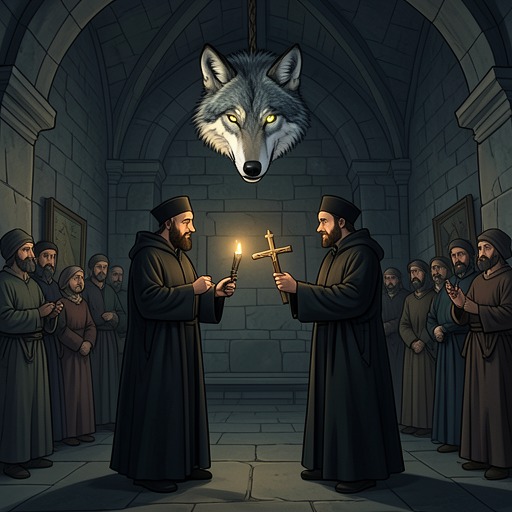
The Best Werewolf Short Stories 1800-1849Father Etienne is the elderly confessor of the Sire of Keridreux, summoned from Ploërmel when the knight faces the approach of twilight and the danger of being driven into the forest as a loup-garou. He enters the episode as a possible spiritual remedy, but becomes its most tormented participant: a priest drawn into a secret rendezvous, a rivalry with Father Bonaventure, and the apparent material evidence of a crime he never intended to commit.
Identity and Introduction
Father Etienne is described as precise and somewhat sour-looking, an elderly monk whose clerical identity gives him authority in the household of the Sire of Keridreux. The knight’s followers hope that his prayers and anathemas may prevent the supernatural transformation, or restore the knight to human form after it begins. His importance therefore rests initially on the assumed power of religious intervention: the approaching twilight is treated as an evil hour, and Father Etienne is the man whose presence might hold it at bay.
His summons is carried by Hugues Wulfric, who is instructed to ride to Ploërmel and bring the confessor back to Château de Keridreux. The urgency is extreme, and the Sire of Keridreux even urges Hugues to attach a pillion so that Father Etienne can be carried behind him. The mission is complicated by the fact that the Dame of Keridreux does not permit anyone to leave the castle without knowing the reason, so Hugues conceals the pillion beneath an old cloak before setting out.
The Letter and the Hidden Rendezvous
Father Etienne believes he has received a letter from the Sire of Keridreux and is relieved when Hugues appears to have delivered the correct message. The letter, however, is actually from the Dame of Keridreux. It presents the knight’s transformation into a loup-garou as the ostensible reason for the summons, then invites Father Etienne to meet her privately at dusk, climb the private stair, and enter the closet without interruption. The supposed request for spiritual assistance is thus a disguised invitation to an adulterous encounter.
The letter reveals the Dame of Keridreux’s double purpose: she uses the supernatural crisis surrounding her husband to summon a lover while pretending to seek a cure. Father Etienne recognizes the danger almost immediately. He worries that his presence at the castle, his secret appointment with the dame, and his failure to object to her intentions could make him appear to be a conspirator in the knight’s destruction. His religious language does not erase the practical fear beneath it; he imagines himself implicated either in murder or in the impious condemnation of a gentleman to a lifelong existence in the forest as a wolf.
Rivalry with Father Bonaventure
Father Etienne’s danger is intensified by the presence of Father Bonaventure, the Dame of Keridreux’s former confessor and rival. Father Etienne fears Bonaventure’s jealous scrutiny, while Bonaventure privately suspects that the dame has summoned the knight’s confessor in order to replace him. Their rivalry is therefore both clerical and sexual: each monk believes the other may expose his connection with the dame, yet neither understands the full confusion produced by the two letters.
Hugues delivers the second letter to Father Bonaventure, whose sleek, plump appearance and sinister cast in one eye contrast with his outward good humour. Both monks separately try to determine whether the way to the stable is clear, and each retreats when he encounters the other. Their repeated evasions turn the rescue mission into a farce of mutual concealment. Hugues watches the delay with mounting desperation as the sun sets and the warder’s horn sounds from tower to tower, warning that the knight’s transformation may already have begun.
The Ride to Château de Keridreux
When Father Etienne finally approaches the waiting horse, he pauses to look cautiously around him. Hugues, fearing that the monk will retreat again, lifts him bodily onto the saddle, mounts the pillion behind him, and gallops away. Father Etienne clings to the horse’s mane with one hand and to Hugues’s uncombed beard with the other. The jolting ride forces prayers and curses from him by turns, while Hugues drives the horse onward with whip, spur, and voice toward the darkening Château de Keridreux.
Father Bonaventure follows on a palfrey, producing the appearance of a phantom pursuit. When his horse stumbles while leaping a ditch, he vanishes from Father Etienne’s sight. Father Etienne interprets the disappearance as supernatural and anathematizes the supposed phantom horseman with the bitterest curses of the Church. He reaches the castle safely, but Hugues immediately drags the horse to the stable and resolves never again to ride double with a priest.
At the secret stair, Father Etienne finds complete darkness. The Dame of Keridreux signals him with a hiss and throws her arm around his neck. She reproaches him for his delay, claiming that another moment would have forced her either to accuse him of conspiracy before the knight or to stab herself in the corridor. Her urgency confirms that the rendezvous is not a pastoral consultation but a dangerous clandestine affair. Father Etienne, feeling his heart beat strongly and almost audibly, begins searching for a way to escape what he has entered.
The Clothes and the Crisis of Conscience
The escape is made possible by a misunderstanding. Father Etienne is given a bundle that he assumes to be a pillion or travel equipment. After being returned to the convent, he discovers that it contains the everyday clothes of the Sire of Keridreux. The garments are not merely clothing in his imagination; they become the corpus delicti of an apparent crime. He believes that possessing them makes him look like a convicted criminal before God and humanity, because the knight has disappeared and has reportedly become a loup-garou.
His reaction combines genuine repentance with comic self-exculpation. He curses the moment of his birth, the horse that carried him, and the master who forced him into what he calls the snares of hell. He asks, in effect, why other people’s sins should require his sanction: if there is treason, murder, or the turning of a husband into a beast, why should he be the one left hiding the old doublet? In a frenzy of fear and rage, he kicks the clothes around his cell, beats his breast, and tears handfuls of hair from his beard.
The following morning Father Bonaventure appears at matins as though nothing has happened, reviving Father Etienne’s jealousy. Etienne thinks that every misfortune of the previous night should have fallen to Bonaventure instead. His resentment is not only moral; he feels that Bonaventure has escaped the dangers and humiliations that ought to have been his rival’s share, from the gallop and the embrace to the possession of the incriminating doublet.
Transfer of Guilt and Narrative Role
When news reaches the convent that the Sire of Keridreux has been converted into a loup-garou and that the search for both the knight and his clothes has failed, Father Etienne becomes frantic. He cannot tolerate carrying away, in a single evening of confessorship, what Father Bonaventure supposedly deserves after a year of illicit labour. He therefore secretly carries the mysterious bundle into Bonaventure’s cell, intending to return the evidence to the rival he believes should bear it.
Father Bonaventure does not know the bundle’s true source. The Dame of Keridreux had instructed Hugues merely to fasten it to the monk’s palfrey, and the two monks had proceeded through the house without realizing that the other was present. Bonaventure consequently assumes that the clothes came directly from the dame and that her fear had driven her to dispose of the proofs of their mutual guilt. Father Etienne’s attempt to transfer responsibility thus deepens the misunderstanding rather than resolving it.
Father Etienne’s episode is built on inversion. The confessor summoned to defeat the supernatural crisis cannot even reach the castle without being physically carried onto a horse; the priest who fears a phantom pursuer mistakes an ordinary accident for a demonic apparition; and the monk who believes himself entangled in murder treats a bundle of clothing as conclusive proof. His prayers, anathemas, and scruples coexist with deception, jealousy, and panic. Through him, the narrative makes religious authority part of the farce: sacred language is repeatedly invoked, but the immediate power over events belongs to secrecy, coincidence, and misunderstanding.